































What is lecithin?
Lecithin is a collective term for a group of phospholipids (phosphatides) that form the building blocks of every cell wall in your body.
Bestsellers
Bekijk allesWinkelwagen
Je winkelwagen is leeg


In stock. Order today, delivered Monday by PostNL.
Not valid with discount codes.
Vragen? We helpen je graag!
Chat met ons of bel 038 303 2160
Snel bezorgd
Besteld voor 17:00, morgen in huis*
Achteraf betalen
met Klarna
Kies opties
Not valid with discount codes.
Vragen? We helpen je graag!
Chat met ons of bel 038 303 2160
Snel bezorgd
Besteld voor 17:00, morgen in huis*
Achteraf betalen
met Klarna
Not valid with discount codes.
Vragen? We helpen je graag!
Chat met ons of bel 038 303 2160
Snel bezorgd
Besteld voor 17:00, morgen in huis*
Achteraf betalen
met Klarna
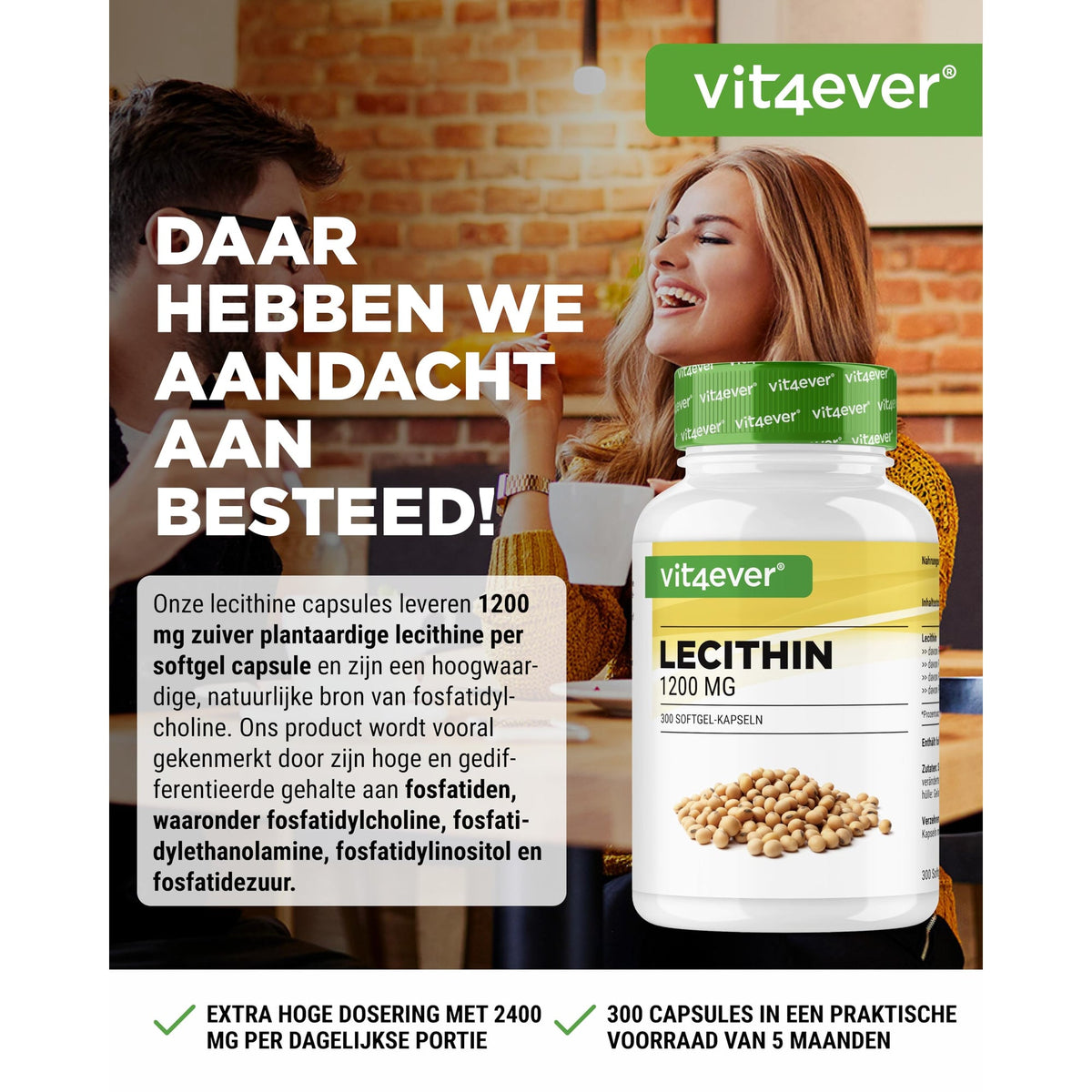
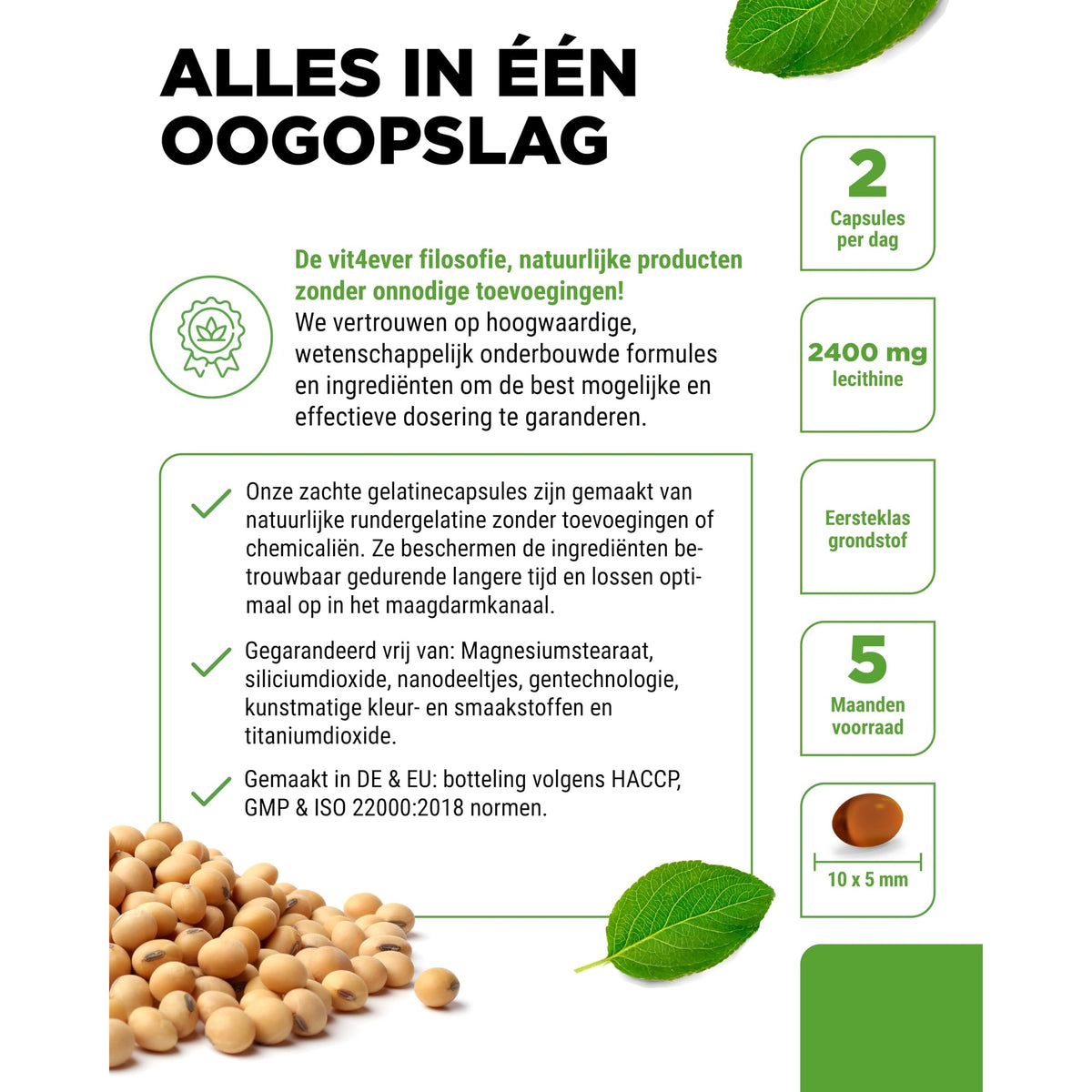
Lecithin is a collective term for a group of fatty substances, called phospholipids, which form the building blocks of every cell wall in your body. For this purpose, Vit4ever uses soy lecithin from non-genetically modified soy, with 1200 mg per softgel, processed in a softgel capsule with an oil base. A daily dose of two softgels provides a total of 2400 mg of lecithin. A jar contains 300 softgels, a supply for about five months.
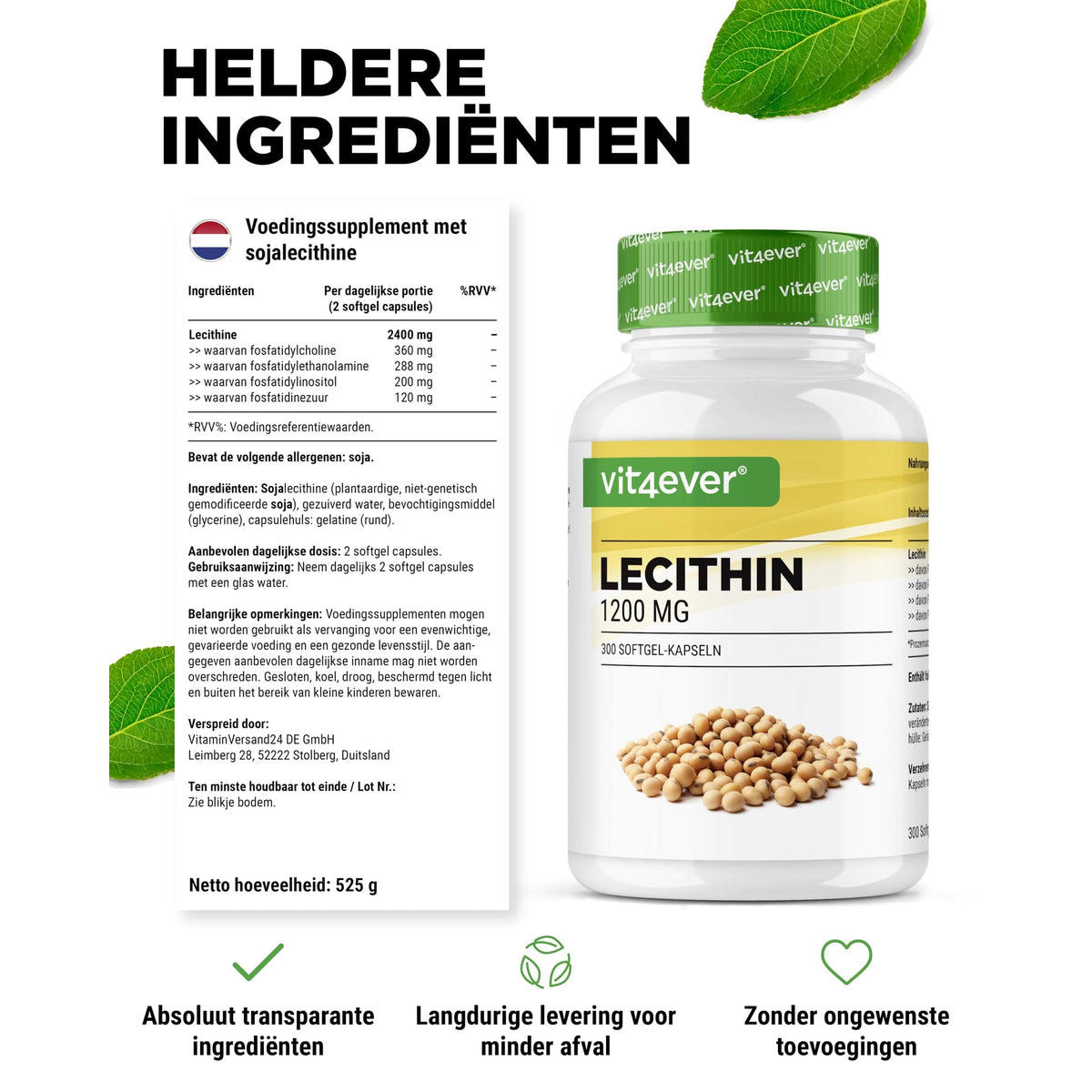
A phospholipid can be compared to a small molecule with two different sides: one side loves water, the other side actually repels water. This property makes phospholipids suitable as building material for cell walls, which after all form a boundary between the watery inside of a cell and the watery environment around it. Lecithin contains several types of phospholipids together, including phosphatidylcholine, phosphatidylethanolamine and phosphatidylinositol. Each of the three has a slightly different chemical structure: they differ in the head group attached to the phosphate part. A daily dose of two softgels provides, among other things, 360 mg of phosphatidylcholine.
Lecithin is naturally found in egg yolk, which is also where the name comes from, the Greek word for egg yolk is lekithos. For dietary supplements, lecithin is nowadays almost always extracted from soybeans instead of egg yolk, because that is more scalable and more consistent in composition than lecithin from egg, and moreover better suited for large-scale production. Vit4ever emphatically uses soybeans that are not genetically modified, a choice that is not taken for granted in a market where a lot of soy is genetically modified. The difference lies in the processing: at Vit4ever, the oil is first pressed out of the soybean, after which the lecithin is mechanically separated from it in a separate process, without chemical solvents that could leave traces in the final product. That is a different process than chemically extracted lecithin, where solvents sometimes do leave residues.
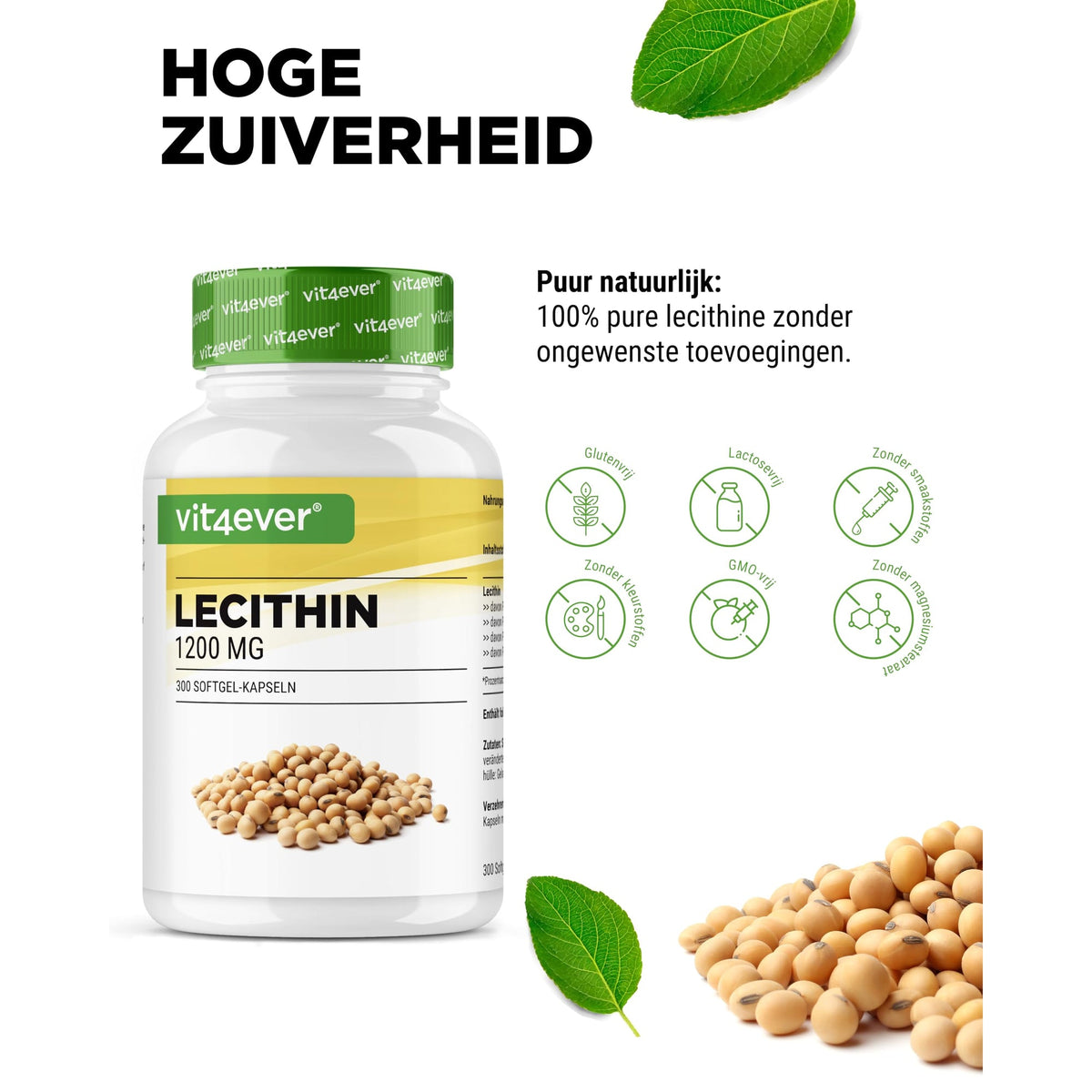
Because lecithin is naturally fat-soluble, Vit4ever processes it in a soft softgel with an oil base instead of in a dry tablet. That fits the nature of the substance: a phospholipid naturally mixes better with oil than with water. The formula is further kept simple, without magnesium stearate, flavorings or colorings, and is GMO-free, lactose-free and gluten-free, which makes the softgel suitable for most common dietary patterns except for a strict vegan or vegetarian diet. The softgel itself is made of beef gelatin with glycerin and water as a humectant, the usual basis for a soft, transparent capsule wall that holds the oil-based filling well without leaking or bursting during transport and storage.
Two important things are good to know before you start using this lecithin product. First, it contains soy lecithin, and thus also soy protein in small amounts; therefore, do not use it in case of a known soy allergy, even though it is a relatively small amount of soy protein per softgel compared to, for example, a soy bar, tofu or edamame. Second, the softgel is made of beef gelatin, which makes this product unsuitable within a vegan or vegetarian dietary pattern, in contrast to most other Vit4ever products that have a plant-based HPMC shell instead of a gelatin-based softgel. Those who prefer to avoid animal gelatin therefore choose another product from the wider assortment, for example a capsule with a plant-based HPMC shell instead of a softgel based on animal gelatin. Every batch of this lecithin is independently checked for purity, in an external laboratory separate from the own production line, so that the composition on the label matches what is actually in the softgel and the stated 1200 mg is correct.
In short: this is soy lecithin in an oil base, packaged in a beef gelatin softgel, with a generous supply of 300 pieces per jar.
Two softgels provide 2400 mg of soy lecithin, of which 360 mg is phosphatidylcholine.
Contains phosphatidylcholine, phosphatidylethanolamine, and phosphatidylinositol together.
The soy lecithin is derived from non-genetically modified soybeans, mechanically separated without chemical solvents.
At two per day, a five-month supply. Each batch independently tested.
* Percentage van de referentie inname volgens Verordening (EU) Nr. 1169/2011.
** Reference intake unknown.
Response within one working day
Our customer service is open on weekdays from 09:00 to 17:00.

Lecithin is a collective term for a group of phospholipids (phosphatides) that form the building blocks of every cell wall in your body.
A daily dose of two softgels provides 2400 mg of soy lecithin, including 360 mg of phosphatidylcholine.
The lecithin is soy lecithin, pressed and mechanically separated from non-genetically modified soybeans.
No. The softgel is made from bovine gelatin with glycerin and water, making the product neither vegan nor vegetarian.
Yes. The product contains soy. Do not use if you have a known soy allergy.
A jar contains 300 softgels. At two per day, this gives you a supply for approximately five months.