













































What is OPC grape seed extract?
OPC grape seed extract is a concentrated extract from grape seeds, rich in oligomeric proanthocyanidins. These plant compounds belong to the group of polyphenols.
Bestsellers
Bekijk allesWinkelwagen
Je winkelwagen is leeg



In stock. Order before 17:00, delivered tomorrow.
Not valid with discount codes.
Vragen? We helpen je graag!
Chat met ons of bel 038 303 2160
Snel bezorgd
Besteld voor 17:00, morgen in huis*
Achteraf betalen
met Klarna
Kies opties
Not valid with discount codes.
Vragen? We helpen je graag!
Chat met ons of bel 038 303 2160
Snel bezorgd
Besteld voor 17:00, morgen in huis*
Achteraf betalen
met Klarna
Not valid with discount codes.
Vragen? We helpen je graag!
Chat met ons of bel 038 303 2160
Snel bezorgd
Besteld voor 17:00, morgen in huis*
Achteraf betalen
met Klarna
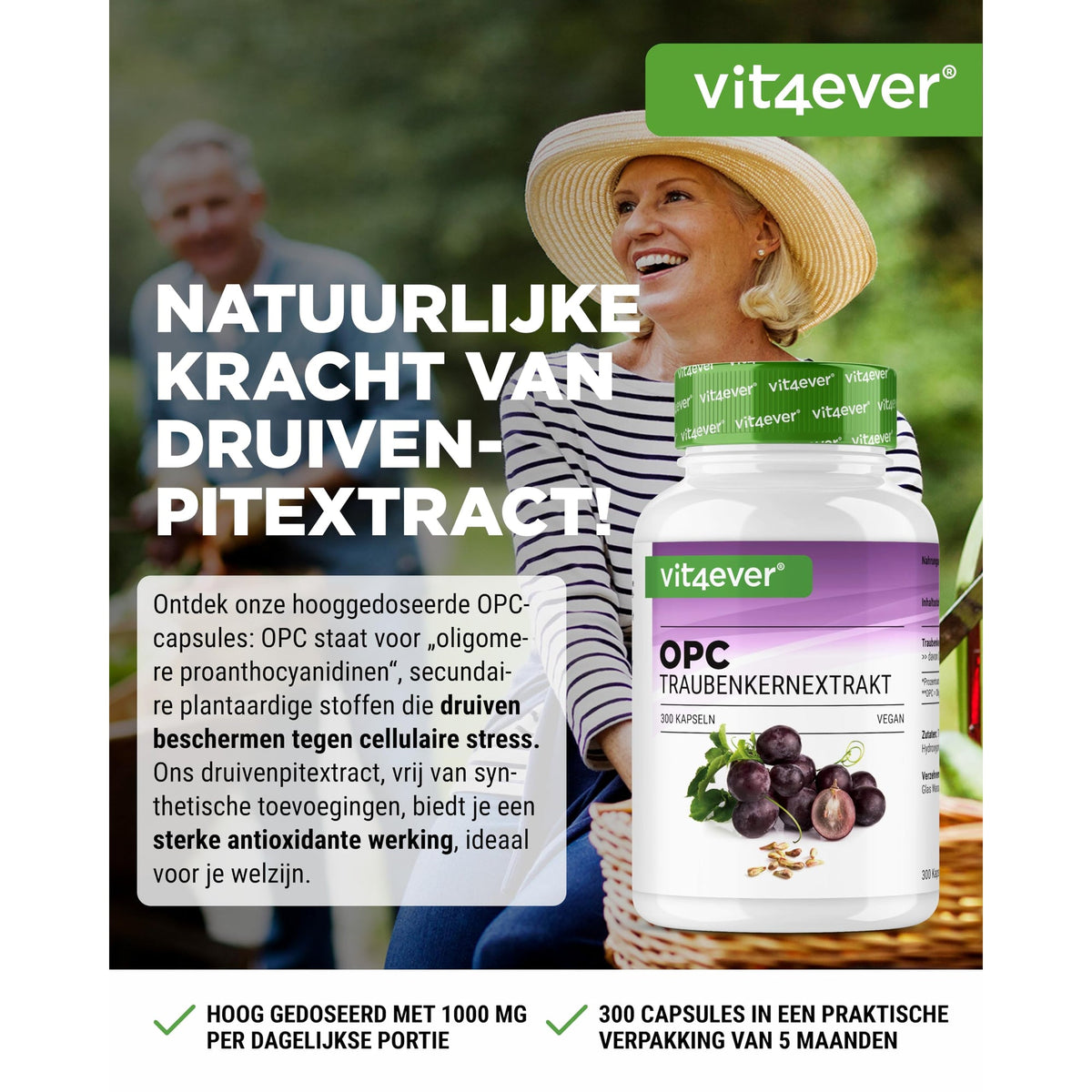
What actually happens to the seeds when grapes are pressed for wine or juice? At Vit4ever, they don't end up in the compost heap, but are processed into OPC grape seed extract, a concentrated source of oligomeric proanthocyanidins (OPC). This extract is standardized to 70 percent OPC and provides 1000 mg of extract, with 700 mg of OPC, when taking two capsules per day. A bottle contains 300 vegan capsules, enough for five months.
OPC is the collective name for a group of polyphenols, plant substances that occur naturally in the skin and seeds of grapes, but also in, for example, cranberries and pine bark. Chemically, they are chains of flavan-3-ol molecules linked together. The extract is standardized to 70% OPC. What many people do not know: grapes build up these substances as a kind of natural protection of the seed against sunlight and insects. During the grape harvest, the seeds often remain as a byproduct of wine or juice production, and it is precisely in them that the highest concentration of OPC in the entire grape is found. Many people wonder whether OPC from grape seeds differs from OPC from, for example, pine bark; the difference lies mainly in the precise composition of the chains. Within the broader family of polyphenols, which also includes substances such as resveratrol and quercetin, OPC from grape seeds distinguishes itself mainly by the relatively short chain length and the high concentration that is bundled in this extract.
Not every grape seed extract is the same. The concentration of OPC varies greatly per manufacturer and per production method. Vit4ever standardizes the extract using the HPLC method (high performance liquid chromatography), a laboratory technique that accurately measures how much OPC is actually in the extract. At 70 percent OPC, you know that you receive 500 mg of extract per capsule with 350 mg of OPC, or 700 mg of OPC per day with two capsules. Without such standardization, you are effectively buying an extract whose actual strength can vary per batch, sometimes by a factor of two or more. The difference therefore is not in the name grape seed extract on the label, but in the number behind it. Vit4ever has each batch independently tested for the actual OPC content, so that the 70 percent on the label is really in the bottle. This control takes place separately from its own production, in an external laboratory, and is intended to prevent a batch with a lower content from still being sold.
The path from grape seed to capsule takes a few steps: first, the seeds are separated from the rest of the grape, dried and ground, then follows an extraction process where the OPC-rich substances are separated from the fiber mass and concentrated into a powder. Only when the OPC content is at the required level does the powder go into the capsule.
The capsule from Vit4ever contains, besides the grape seed extract, only a plant-based capsule shell of hydroxypropyl methylcellulose. There are no fillers, colorings, or magnesium stearate in it, which makes this product suitable for those who prefer a short, recognizable ingredients list. The recommended intake is one capsule twice a day, for example one with breakfast and one with dinner. A bottle of 300 capsules of OPC grape seed extract will last five months in this way, which amounts to approximately 150 day doses. Store the bottle dry and dark, well closed and out of reach of direct sunlight, so that the quality of the extract is preserved until the last capsule.
The OPC content of 70 percent is measured using the HPLC method, ensuring that each batch delivers the same concentration.
Two capsules per day provide 1000 mg extract with 700 mg OPC.
At two capsules a day, one pot lasts five months.
Only grape seed extract and a vegetable capsule shell, without fillers or colorants.
* Percentage van de referentie inname volgens Verordening (EU) Nr. 1169/2011.
** Reference intake unknown.
Response within one working day
Our customer service is open on weekdays from 09:00 to 17:00.

OPC grape seed extract is a concentrated extract from grape seeds, rich in oligomeric proanthocyanidins. These plant compounds belong to the group of polyphenols.
Two capsules per day together provide 1000 mg of grape seed extract, standardized to 70 percent OPC. This equates to 700 mg of OPC per day.
The OPC content in the extract is measured using the HPLC method, a laboratory technique that accurately determines the actual OPC content. With 70 percent, you know exactly how much OPC each capsule provides.
No. Non-standardized extracts can vary greatly in OPC content per batch. By standardizing to 70 percent, you know in advance what you are getting, instead of guessing at the actual concentration.
According to the label: one capsule twice daily, for example with breakfast and dinner. Each capsule contains 500 mg of extract, standardized to 70% OPC.
This variant is a capsule containing only grape seed extract. The powder variant combines the same extract with natural vitamin C from acerola and is intended for those who prefer not to take capsules.