




























What is quercetin?
Quercetin is a natural flavonoid, a yellow plant pigment from the polyphenol group, found in, among other things, apples, onions, and berries.
Bestsellers
Bekijk allesWinkelwagen
Je winkelwagen is leeg



Out of stock.
Not valid with discount codes.
Vragen? We helpen je graag!
Chat met ons of bel 038 303 2160
Snel bezorgd
Besteld voor 17:00, morgen in huis*
Achteraf betalen
met Klarna
Kies opties
Not valid with discount codes.
Vragen? We helpen je graag!
Chat met ons of bel 038 303 2160
Snel bezorgd
Besteld voor 17:00, morgen in huis*
Achteraf betalen
met Klarna
Not valid with discount codes.
Vragen? We helpen je graag!
Chat met ons of bel 038 303 2160
Snel bezorgd
Besteld voor 17:00, morgen in huis*
Achteraf betalen
met Klarna
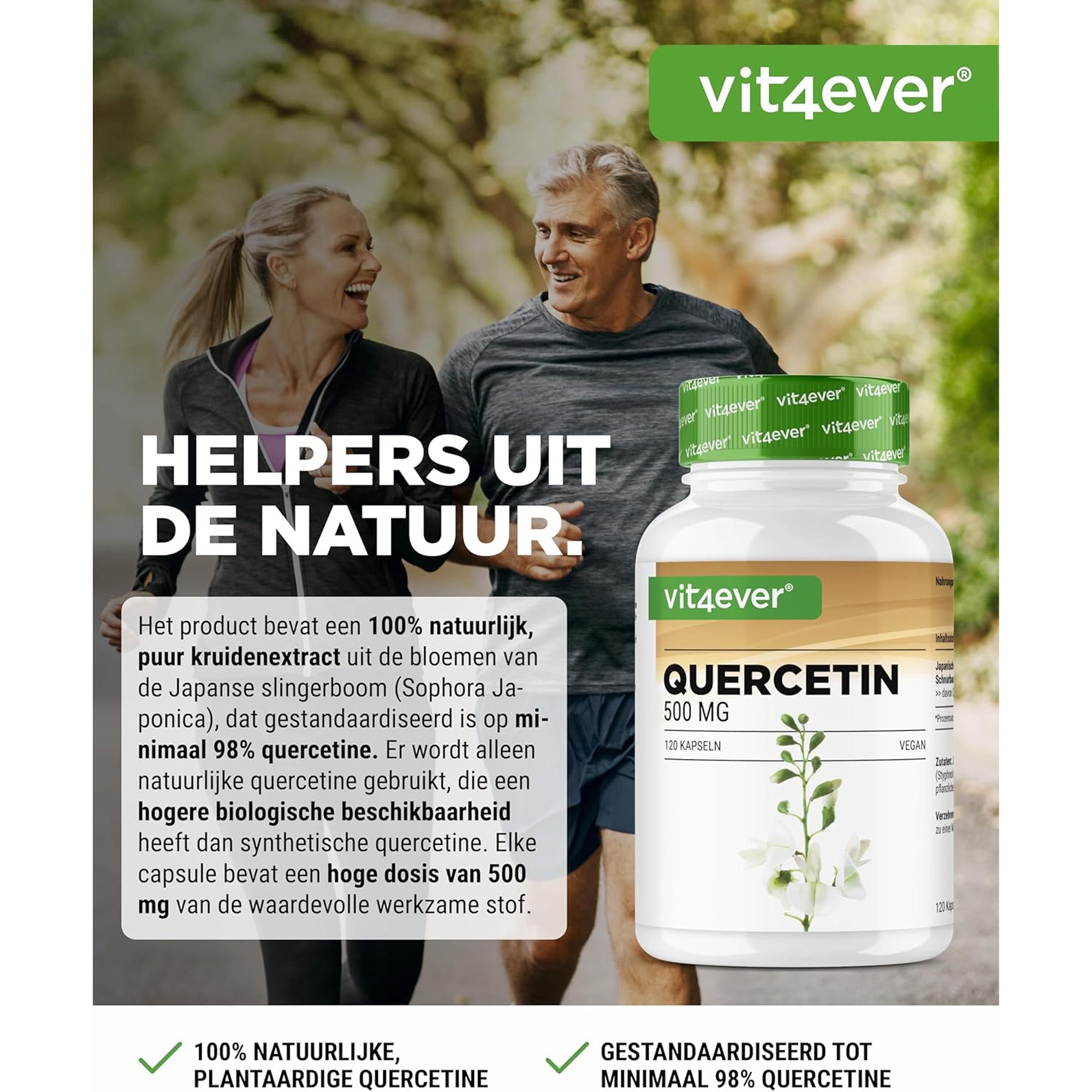
Cut a red onion in half and you will immediately see where this product gets its name: under the skin is a yellow-orange pigment that is very common in the plant world. Quercetin is one such natural flavonoid, a yellow plant pigment that belongs to the polyphenols. It is found in the skins, leaves, and flowers of, among others, apples, onions, and berries. Vit4ever uses quercetin from the flowers of the Japanese honeysuckle (Styphnolobium japonicum). Onions, especially the red variety, and capers are among the most quercetin-rich foods found in an average diet, followed by apple skins and various berries. One jar contains 120 vegan capsules.
The quercetin in this product is obtained from the flower buds of the Japanese honeysuckle through an extraction process. This tree originally comes from East Asia but can now also be found in European parks. What many people do not know is that the name Styphnolobium japonicum does not refer to the plant most people think of when they hear 'honeysuckle', but to a separate tree species in the legume family. Each capsule contains 510 mg of flower extract, of which 500 mg is actually quercetin. To get the same amount through food, you would have to eat a large quantity of onions, capers, or blueberries, considerably more than would fit in an average meal. That extraction process begins with drying the flower buds, followed by a series of steps in which the quercetin is concentrated into the final powder that ends up in the capsule. The extract is standardized, which means that each capsule contains a fixed, controlled amount of quercetin instead of a varying amount like in fresh fruit or fresh vegetables.
Quercetin belongs to the larger group of polyphenols, plant substances that naturally have a colored structure and are therefore often responsible for the color of fruit, vegetables, and flowers. The molecule has a structure that is chemically related to other well-known flavonoids, such as those found in green tea or citrus fruits. After ingestion, quercetin is partially converted in the intestine before it reaches the bloodstream, a process that occurs similarly with various flavonoids. Some people deliberately choose a concentrated extract precisely because they do not want to eat large portions of onions or berries every day to get a comparable amount of quercetin. There is no approved health claim for quercetin.
The capsules contain only Styphnolobium japonicum extract, a small amount of rice extract as an anti-caking agent, and a plant-based capsule shell made of hydroxypropyl methylcellulose. They are free from magnesium stearate, artificial colors, flavorings, and preservatives. This short formulation makes it easy to see exactly what is in a capsule, something that is less obvious with processed extracts containing many excipients. In small amounts, the rice extract ensures that the powder does not clump together during production, a purely technical function with no effect on the quercetin itself. This aligns with the idea behind a clean-label product: as few additives as possible, so that it is clear exactly what you are taking in.
The quercetin capsules are one hundred percent vegan and suitable for those who choose a clean-label supplement without animal-derived ingredients. For people who prefer not to use animal gelatin in their supplements, this is a relevant detail, as many other capsules are still made from beef gelatin. One capsule per day, with a meal and sufficient water, is enough according to the recommended use. Each produced batch is independently tested for content and purity, so that the 500 mg on the label actually corresponds to the contents of the capsule. It is also checked whether the quercetin content in the extract remains stable throughout the shelf life, something that is not guaranteed with plant extracts. This provides more certainty than with individual food items, where the amount of quercetin per piece of fruit or vegetable can vary greatly. With 120 capsules in a jar and one capsule per day, you get four months' supply, a manageable amount to try this extract.
Each capsule contains 510 mg flower extract, of which 500 mg is quercetin, a fixed and standardized amount.
Obtained from the flower buds of Styphnolobium japonicum through a controlled extraction process.
Without magnesium stearate, artificial colors, flavors or preservatives, with only three ingredients.
One capsule per day, four months' supply. Vegan and independently tested for content per batch.
* Percentage van de referentie inname volgens Verordening (EU) Nr. 1169/2011.
** Reference intake unknown.
Response within one working day
Our customer service is open on weekdays from 09:00 to 17:00.

Quercetin is a natural flavonoid, a yellow plant pigment from the polyphenol group, found in, among other things, apples, onions, and berries.
Each capsule contains 510 mg of flower extract, of which 500 mg is actual quercetin. The extract is standardized to a fixed amount.
The quercetin is extracted from the flower buds of the Japanese pagoda tree (Styphnolobium japonicum), a tree native to East Asia.
Yes. The capsules are 100 percent vegan with a plant-based capsule shell made of hydroxypropyl methylcellulose, without animal ingredients.
The recommended dosage is one capsule per day with a meal and sufficient water. Do not exceed this amount.
Quercetin is present in food in varying, often small, amounts. This capsule contains a fixed, standardised amount of 500 mg per capsule.