








































Where does the resveratrol in this product come from?
From the root of Japanese knotweed (Polygonum cuspidatum). This is the most common source of resveratrol in supplements, because the root naturally contains a lot of it.
Bestsellers
Bekijk allesWinkelwagen
Je winkelwagen is leeg

In stock. Order before 17:00, delivered tomorrow.
Not valid with discount codes.
Dosage
Vragen? We helpen je graag!
Chat met ons of bel 038 303 2160
Snel bezorgd
Besteld voor 17:00, morgen in huis*
Achteraf betalen
met Klarna
Kies opties
Not valid with discount codes.
Dosage
Vragen? We helpen je graag!
Chat met ons of bel 038 303 2160
Snel bezorgd
Besteld voor 17:00, morgen in huis*
Achteraf betalen
met Klarna
Not valid with discount codes.
Dosage
Vragen? We helpen je graag!
Chat met ons of bel 038 303 2160
Snel bezorgd
Besteld voor 17:00, morgen in huis*
Achteraf betalen
met Klarna
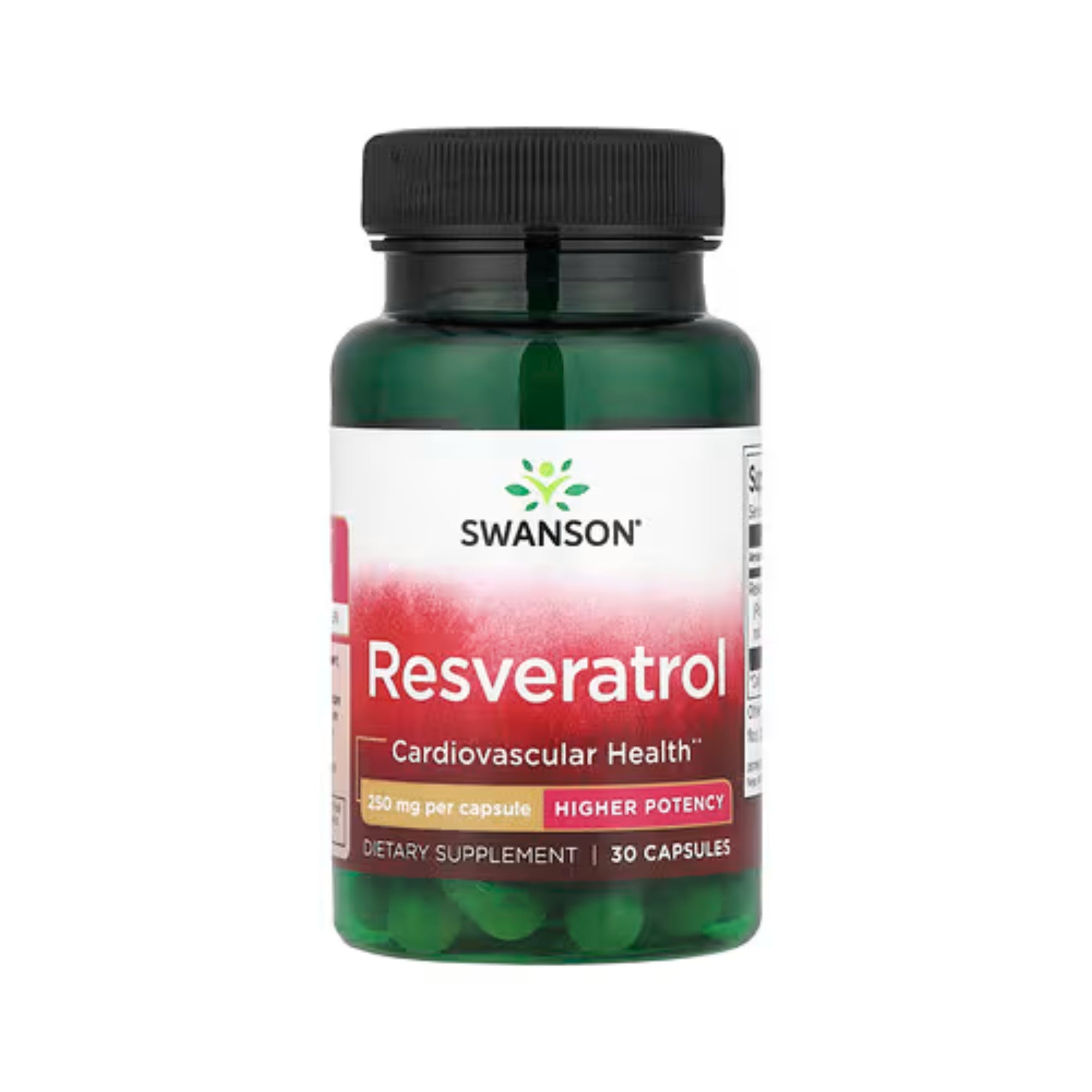
These capsules from Swanson provide resveratrol, a plant compound that is naturally found in red wine and grape skins, among other things. Each capsule contains 250 milligrams. The resveratrol is derived from the root of Japanese knotweed (Polygonum cuspidatum), the source from which this compound is most easily extracted. You take one capsule per day, so a bottle of 30 lasts for one month.
Resveratrol belongs to the polyphenols, a large group of compounds that plants produce themselves. Within that group, it is classified as a stilbene. You will find resveratrol mainly in the skin of blue grapes, in red wine, and in certain roots. Plants produce it in response to stress, for example during a fungal attack or exposure to a lot of UV light. It is therefore a compound that a plant produces to protect itself. In supplements, Japanese knotweed root is usually used, simply because it contains a lot of resveratrol.
Japanese knotweed is the most commonly used source of resveratrol in supplements. The root contains a relatively high amount, so you do not need liters of wine to get the same amount. One glass of red wine provides only a fraction. This capsule contains 250 milligrams of resveratrol from that root, a fixed amount that remains the same per capsule. This way, you know exactly how much you are taking every day, without having to guess.
Attention for resveratrol was initially focused mainly on the compound in red wine. After that, the focus shifted to concentrated forms from Japanese knotweed root, such as this capsule.
Interest in resveratrol began with the compound in red wine. Researchers began examining the ingredients of wine and thus came across resveratrol. Chemically, there are two forms: trans-resveratrol and cis-resveratrol. The trans form is the most common form in supplements. In supplements made from Japanese knotweed root, it is mainly this trans form. Because the root contains so much resveratrol, a single capsule provides an amount that you would otherwise have to drink a considerable number of glasses of wine to obtain. And that is without the alcohol and sugars found in wine.
Resveratrol from Japanese knotweed is a concentrated way to get this much-discussed plant compound without needing wine. Swanson provides it in a simple capsule containing 250 milligrams each.
Each capsule contains a fixed amount of 250 milligrams (250 mg variant) or 100 milligrams (100 mg variant) of resveratrol. This amount remains the same per capsule, so you know exactly what you are taking.
The resveratrol comes from the root of Polygonum cuspidatum, the most common source in supplements. This plant naturally contains a high amount of this plant compound.
You take one capsule per day. A jar of 30 will therefore last a month, without you having to calculate or combine.
To get 100 or 250 milligrams of resveratrol from wine, you would need quite a few glasses. One capsule delivers that amount all at once, from a plant root.
* Percentage van de referentie inname volgens Verordening (EU) Nr. 1169/2011.
** Reference intake unknown.
Response within one working day
Our customer service is open on weekdays from 09:00 to 17:00.

From the root of Japanese knotweed (Polygonum cuspidatum). This is the most common source of resveratrol in supplements, because the root naturally contains a lot of it.
Resveratrol is a plant compound from the group of polyphenols, and within that, a stilbene. It is found, among other places, in the skin of blue grapes and in red wine. Plants produce it as a response to stress.
That depends on the variant: 250 milligrams (250 mg variant) or 100 milligrams (100 mg variant) per capsule. You take one per day, so that is also your daily dose.
No. The capsule is made of gelatin, an animal-derived material. Therefore, those who wish to avoid animal ingredients should not use this product.
Chemically, resveratrol exists in two forms: trans and cis. In supplements made from knotweed root, it is mainly trans-resveratrol.
The substance itself is the same. The difference lies in the concentration. You get much more resveratrol per gram from Japanese knotweed root than from wine or grapes, which means a capsule can provide a fixed, higher amount.