





























What is rhodiola rosea?
Rhodiola rosea, also known as roseroot or golden root, is a plant from cold mountain regions. This product contains a standardised extract of the root.
Bestsellers
Bekijk allesWinkelwagen
Je winkelwagen is leeg



In stock. Order today, delivered Monday by PostNL.
Not valid with discount codes.
Vragen? We helpen je graag!
Chat met ons of bel 038 303 2160
Snel bezorgd
Besteld voor 17:00, morgen in huis*
Achteraf betalen
met Klarna
Kies opties
Not valid with discount codes.
Vragen? We helpen je graag!
Chat met ons of bel 038 303 2160
Snel bezorgd
Besteld voor 17:00, morgen in huis*
Achteraf betalen
met Klarna
Not valid with discount codes.
Vragen? We helpen je graag!
Chat met ons of bel 038 303 2160
Snel bezorgd
Besteld voor 17:00, morgen in huis*
Achteraf betalen
met Klarna
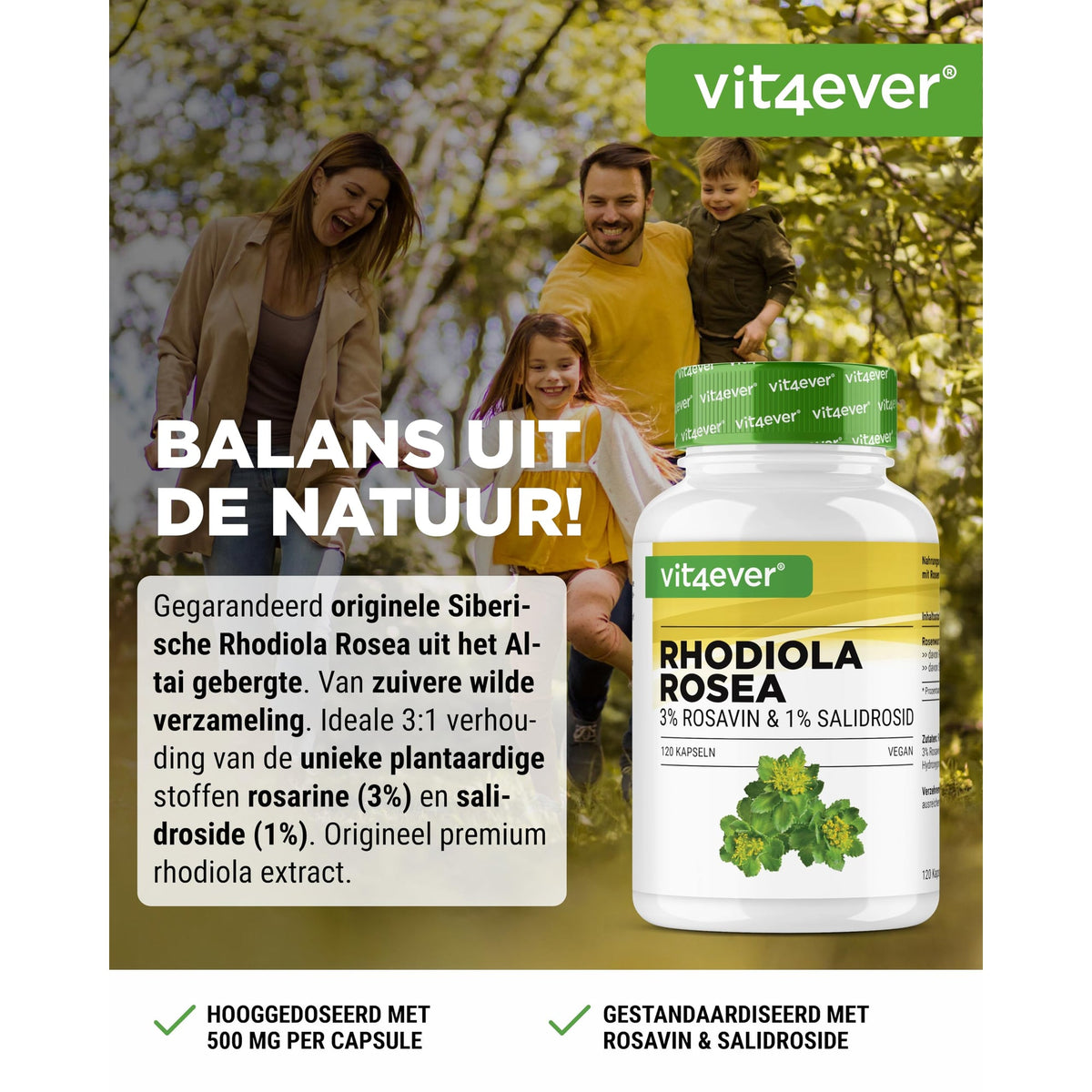
Rhodiola rosea, also known as rose root or golden root, has grown for centuries in the chilly mountain regions of Scandinavia, Siberia, and parts of Asia. Vit4ever processes the root into a standardized extract of 500 mg per capsule, with 3 percent rosavine and 1 percent salidroside. One capsule per day is enough, and a bottle of 120 capsules will last about four months.
Rhodiola rosea is a succulent that grows in cold, high-altitude, and often windy areas, far from the beaten path. In Siberian, Scandinavian, and Eastern European traditions, the root has been used for centuries, and that is exactly the part of the plant that is harvested. It is precisely in the root that the characteristic plant substances rosavine and salidroside are found in the highest concentration. After harvesting, the root is dried and converted into a concentrated extract through a careful extraction process. Vit4ever deliberately chooses the root as a raw material and not the leaf or stem, because the characteristic plant substances are most concentrated there. Anyone encountering rhodiola rosea for the first time will soon see that the plant has been used in the Scandinavian and Russian herbal tradition for decades, long before it appeared as a supplement in Dutch stores. The name golden root refers to the golden-yellow color of the root flesh as soon as it is cut through, a characteristic that harvesters used to select for.
Standardizing means that an extract is adjusted to a fixed, predetermined amount of certain plant substances. For this extract, that means 3 percent rosavine and 1 percent salidroside, in the 3:1 ratio that often serves as a quality standard for rhodiola extracts. Per capsule, that comes down to 15 mg rosavine and 5 mg salidroside, always the same amount, batch after batch. Loose root powder lacks that certainty: the content of these plant substances can vary greatly per harvest and origin, sometimes by a factor of two or more. Rhodiola rosea supports the body's adaptability to emotional stress and physical exertion*. Many people wonder how rhodiola compares to other herbs such as ashwagandha or ginseng. The difference lies in the precise plant substances: rosavine occurs almost exclusively in Rhodiola rosea, while other Rhodiola species, such as Rhodiola crenulata, contain little or no substance. Therefore, the botanical name on the label is more important than the common name rose root alone. Extract ratios are often indicated differently for rhodiola than for example ginkgo: not as a ratio between dry and fresh material, but as a percentage of the two characteristic substances, which actually makes the comparison between products easier in practice.
Rhodiola rosea supports mental and cognitive function*. The root has a long history of use in Russia and the Scandinavian countries, where the climate and short summers previously gave people a reason to look into such herbs. In traditional application, rhodiola rosea is often taken daily and at fixed times, which aligns with the advice of one fixed capsule per day.
The capsule consists of nothing other than the rhodiola extract itself and a plant-based shell of hydroxypropyl methylcellulose (HPMC), a substance that ensures the capsule keeps its shape and is easy to swallow. It contains no magnesium stearate, PEG, carrageenan, flavoring, or coloring. That makes it suitable for vegans and eliminates a lot of unnecessary substances from the label. Every batch is checked for purity and content in an independent laboratory, so that you get the same quality from bottle to bottle. In short: standardization and a short ingredient list go hand in hand here. By the way, precisely because no fillers have been added to the capsule, the dosage of 500 mg of extract per capsule remains clearly traceable to the 15 mg rosavine and 5 mg salidroside that you receive. Anyone who has tried root powder or a non-standardized extract often notices this difference the fastest: with this extract you know exactly what is in it beforehand, instead of relying on an estimate from the manufacturer.
Rhodiola rosea thus remains a herb with a long history of use in cold regions, now packaged in a modern, standardized form. For those who prefer working with a fixed, measurable dosage than with loose root powder, that is a pleasant difference, and the short ingredient list makes exactly clear what is in every capsule.
*Health claim awaiting European approval.
One capsule per day provides 500 mg of rhodiola rosea extract.
3% rosavin and 1% salidroside, or 15 mg and 5 mg per capsule, for a consistent composition per batch.
Only the extract and a plant-based capsule. No magnesium stearate, PEG, carrageenan, flavouring or colouring.
120 plant-based capsules per pot, sufficient for four months at one capsule per day.
* Percentage van de referentie inname volgens Verordening (EU) Nr. 1169/2011.
** Reference intake unknown.
Response within one working day
Our customer service is open on weekdays from 09:00 to 17:00.

Rhodiola rosea, also known as roseroot or golden root, is a plant from cold mountain regions. This product contains a standardised extract of the root.
For 3% rosavin and 1% salidroside, the characteristic plant compounds. Per capsule, this amounts to 15 mg rosavin and 5 mg salidroside.
One capsule per day, swallowed whole with sufficient water, preferably with a meal. A jar contains 120 capsules, enough for four months.
Yes. The capsule contains only rhodiola extract and a plant-based HPMC casing. No magnesium stearate, PEG, carrageenan, flavouring, or colouring.
Rhodiola rosea is preferably not used during pregnancy or breastfeeding. If in doubt or if you are taking medication, consult a doctor in advance.
Rosavin, one of the two characteristic plant compounds, is found almost exclusively in Rhodiola rosea. Other species, such as Rhodiola crenulata, contain little to none of this substance. This extract is therefore specifically standardised for Rhodiola rosea.