


































Isn't 300mcg of vitamin K2 too much?
For healthy adults, EFSA has not set an upper limit for vitamin K. 300mcg is 400 percent of the reference intake. If you use blood thinners, always consult your doctor first.
Bestsellers
Bekijk allesWinkelwagen
Je winkelwagen is leeg

In stock. Order today, delivered Monday by PostNL.
Not valid with discount codes.
Vragen? We helpen je graag!
Chat met ons of bel 038 303 2160
Snel bezorgd
Besteld voor 17:00, morgen in huis*
Achteraf betalen
met Klarna
Kies opties
Not valid with discount codes.
Vragen? We helpen je graag!
Chat met ons of bel 038 303 2160
Snel bezorgd
Besteld voor 17:00, morgen in huis*
Achteraf betalen
met Klarna
Not valid with discount codes.
Vragen? We helpen je graag!
Chat met ons of bel 038 303 2160
Snel bezorgd
Besteld voor 17:00, morgen in huis*
Achteraf betalen
met Klarna
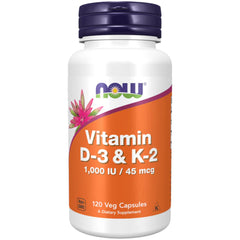
This capsule is for those seeking a higher dose. You get 300mcg of vitamin K2 per capsule, as MK-7 from MenaQ7. That is three times as much as the standard version from Now. One capsule per day, sixty in a bottle, in a plant-based cellulose capsule.
Vitamin K2 is technically called menaquinone. There are several menaquinones, from MK-4 to MK-13, and the number indicates how many building blocks (isoprene units) are in the tail of the molecule. MK-7 has seven. That long tail makes the molecule more soluble in fat, allowing your body to keep it in circulation for a long time, with a half-life of about three days. For comparison: vitamin K1 from vegetables and the shorter MK-4 are largely gone from your blood within a few hours. MK-7 is naturally found mainly in natto, fermented soybeans from Japan. By the way, your own gut bacteria also produce small amounts of menaquinones, although it is unclear how much of that your body actually uses. Now chooses MenaQ7, a patented raw material. It consists almost entirely of the all-trans form, the spatial form of the molecule that your body recognizes and uses.
In your body, vitamin K acts as a co-factor (a helper molecule) for the enzyme gamma-glutamyl carboxylase. That enzyme modifies certain proteins so that they can bind calcium. Only then are they active. In your liver, it is about clotting factors. Vitamin K contributes to normal blood clotting. In your bones, it is about osteocalcin, a protein made by bone-forming cells. Vitamin K contributes to the maintenance of normal bones. MK-7 has a longer half-life than vitamin K1 and MK-4.
The reference intake (RI) for vitamin K is 75mcg per day. This capsule provides 400 percent of that. That sounds like a lot, but EFSA has not established a maximum safe upper limit for vitamin K, because no adverse effects of high intake are known in healthy people. Many people wonder whether they should take 100 or 300mcg of vitamin K2. In short: the 100mcg variant is a daily basic, you choose this Extra Strength if you are consciously looking for a higher amount.
The Extra Strength has a different, shorter ingredient list than the 100mcg version. In addition to MK-7, it only contains microcrystalline cellulose as a filler and a little silicon dioxide, so that the powder does not clump. The capsule is made of hypromellose, a plant-based cellulose. Now makes these capsules without wheat, gluten, soy, milk, egg, fish, shellfish, or nuts, in a GMP-certified factory in the United States. Notably: rice flour and maltodextrin, which are in the 100mcg capsule, are missing here.
For those who know exactly what they are looking for: a lot of vitamin K2 in one small capsule per day. Sixty capsules means two months, without the hassle of drops or combination products.
Three times the standard version, for those consciously seeking a higher daily amount.
This form stays in circulation much longer than K1 or MK-4, so one capsule a day is enough.
MK-7, microcrystalline cellulose, silicon dioxide and the cellulose capsule. That's all there is.
Made without wheat, gluten, soy, milk, egg, fish, shellfish or nuts, in a hypromellose capsule.
* Percentage van de referentie inname volgens Verordening (EU) Nr. 1169/2011.
** Reference intake unknown.
Response within one working day
Our customer service is open on weekdays from 09:00 to 17:00.

For healthy adults, EFSA has not set an upper limit for vitamin K. 300mcg is 400 percent of the reference intake. If you use blood thinners, always consult your doctor first.
With a meal, preferably one containing some fat. Vitamin K2 dissolves in fat, so your body absorbs it more easily. The time of day doesn't matter much, as MK-7 stays in your bloodstream for a long time.
The richest source of MK-7 is natto, fermented soybeans from Japan. Hard cheeses, quark, egg yolk and liver contain other forms of K2, such as MK-4, MK-8 and MK-9. In a typical Dutch diet, the amount of MK-7 is usually small.
Because with one capsule you get a higher daily amount, without swallowing multiple capsules. If you are mainly looking for a basic around the reference intake, then the 100mcg variant from Now is a better fit.
Vitamin K is a cofactor for an enzyme that activates proteins so they can bind calcium. Vitamin K contributes to normal blood clotting. Vitamin K contributes to the maintenance of normal bones, partly through the protein osteocalcin.
K1 comes from green vegetables and your liver mainly uses it for blood clotting. K2 comes from fermented and animal products and stays in your blood much longer, especially as MK-7.